Roman Catholic Liturgical Rites for the Sick and Dying
Vatican II introduced changes to liturgical rites for the sick and dying that enable a layperson to preside in the absence of a priest or deacon. In the general introduction on Holy Communion outside the Mass approved for publication by the US Bishops Committee on Divine Worship, it is written:
It is proper that those who are prevented from being present at the community’s celebration should be refreshed with the Eucharist. In this way they may realize that they are united not only with the Lord’s sacrifice but also with the community itself and are supported by the love of their brothers and sisters.[19]
This description echoes back to the early Christians bringing the Eucharist in their role as servants to their community members who could not be with them.
The Rites are intended where appropriate to be communal celebrations. Family, friends and caregivers should be invited to participate. Eileen Crowley discusses the importance of engaging all who are assembled together so the bounty of everyone’s gifts can be appreciated in her booklet: To Serve with Joy and Courage: Fundamentals for Lay Presiding.[28] She reminds us of the need to serve with humility and as a prayerful servant of God. If a participant is willing and comfortable she or he can proclaim the readings, lead responses and state intentions in prayer. The readings, responses, and intentions can be shared by multiple people present who are willing to serve in these roles. Be sensitive to the person’s liturgical background. A person who was a choir member may have a favorite song to sing, or wish to hear sung to them. If the person has a family or personal Bible with them, the readings could be done from their book. If the person has a favorite prayer they like to pray that can be added and prayed in the liturgy.
Sometimes we encounter people who do not speak English, and many parishes have Spanish speaking translations of the liturgy. If the patient does not understand English and there is someone who can help translate and explain, then the person can pray in their own language as you pray in English.
It is proper that those who are prevented from being present at the community’s celebration should be refreshed with the Eucharist. In this way they may realize that they are united not only with the Lord’s sacrifice but also with the community itself and are supported by the love of their brothers and sisters.[19]
This description echoes back to the early Christians bringing the Eucharist in their role as servants to their community members who could not be with them.
The Rites are intended where appropriate to be communal celebrations. Family, friends and caregivers should be invited to participate. Eileen Crowley discusses the importance of engaging all who are assembled together so the bounty of everyone’s gifts can be appreciated in her booklet: To Serve with Joy and Courage: Fundamentals for Lay Presiding.[28] She reminds us of the need to serve with humility and as a prayerful servant of God. If a participant is willing and comfortable she or he can proclaim the readings, lead responses and state intentions in prayer. The readings, responses, and intentions can be shared by multiple people present who are willing to serve in these roles. Be sensitive to the person’s liturgical background. A person who was a choir member may have a favorite song to sing, or wish to hear sung to them. If the person has a family or personal Bible with them, the readings could be done from their book. If the person has a favorite prayer they like to pray that can be added and prayed in the liturgy.
Sometimes we encounter people who do not speak English, and many parishes have Spanish speaking translations of the liturgy. If the patient does not understand English and there is someone who can help translate and explain, then the person can pray in their own language as you pray in English.
Communion of the Sick
|
There are two Rites that can be used for visitation of the sick and distribution of communion by Extraordinary Ministers: The Ordinary Rite of Communion of the Sick and the Short Rite of the Communion of the Sick.[20] The latter rite is to be used in hospital or institutional visits when Communion is given in many different rooms in the same building.
|
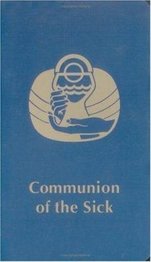
This is the booklet used by Ministers of Care that contains the Rites for the sick. You can order from Amazon or contact your Minister of Care Coordinator for a copy.

This is an example of a pyx that is used to bring the Eucharist to the sick in their homes and institutions. |
The Ordinary Rite of Communion of the Sick[21] |
Pastoral Care of the Sick[23] |
|
This liturgy has four components:
Introductory Rite - Greeting and Penitential Act Short Form Reading of the Word - A brief passage from scripture can be read by the minister or one of those present Holy Communion - Lord’s Prayer, Invitation to Communion, Communion Concluding Prayer - Prefaced by a period of silence The Short Rite of the Communion of the Sick[22]This liturgy has four components, and elements from the ordinary rite may be added according to the circumstances. Some parishes have an adapted form that can be used.
Antiphon - (a short introductory scripture verse) Invitation to Communion Communion Concluding prayer |
The Rites also offer liturgical recommendations for Pastoral Care of the Sick that does not include the distribution of communion. Many people in hospital are not able to receive communion due to dietary and health restrictions, and this rite could be followed for them. People who are in the hospital and waiting for surgery are usually fasting, and their anxiety and worry is very high, so the ability to pray with them and offer comfort and support is especially important at that time.
The Visit to the Sick liturgy has five components: Reading - followed by a brief silence Response - An appropriate psalm can be used such as Psalm 102 or 27 The Lord’s Prayer Concluding Prayer Blessing |
Pastoral Care of the Dying
 Cemetary @ Taos Pueblo New Mexico Cemetary @ Taos Pueblo New Mexico
|
We Ministers of Care will not typically be performing liturgies that are used for the dying and dead when we visit people, but it is best to be prepared and to understand these liturgies. We also never know when a person may take a sudden turn for the worse, and we should know the special prayers and liturgies that can be offered with them and their loved ones.
Sharon Dobb's personal experience: I can recall entering someone’s hospital room shortly after their moment of death. The family was grieving around their bedside, and requested that we pray together. I was not prepared for that moment, and I struggled to think about how we could best gather in prayer for the deceased person. |
Viaticum[24]Eucharist offered to a Baptized person approaching death is called Viaticum and may be offered with or without anointing. The ancient Greeks and Romans used to give a special supper to people setting out on a journey. The word Viaticum originates from the Latin word “viaticus” meaning “pertaining to a road or journey.”[25] Viaticum then is the provisioning of a person for passage out of this world into the next.
Using John 6:54 we can relate relate the concept of Viaticum to our eternal life: “Those who eat my flesh and drink my blood have eternal life, and I will raise them up on the last day.” Ordained priests and deacons offer Viaticum, but if there is no ordained clergy available, any member of the faithful who has been duly appointed can offer a final Eucharist. This liturgy includes the person professing their baptismal promises and has six components: Introductory Rite - Greeting, Instruction, and Penitential Act Short Form Reading of the Word - A brief passage from scripture can be read by the minister or one of those present Profession of Baptismal Faith Prayer for the Sick Person Viaticum - Lord’s Prayer, Invitation to Communion, Communion Concluding Rite - Prefaced by a period of silence |
Commendation of the Dying[26]This Liturgy may be performed by a member of the community if a priest or deacon is not available. The prayers should be prayed in a slow quiet voice and alternate with periods of silence. The prayers may be repeated two or three times, and may also be done with friends and family members if the dying person is not conscious. The liturgy has six components:
Short Texts - Recited with the dying person, and may be repeated Reading Litany of the Saints - Special mention can be made of the patron saint of the person or family and of the parish. This may be said or sung. Prayer of Commendation - Prayed when the moment of death seems near Prayer after Death Prayer for the Family and Friends |
Prayers after Death[27]This liturgy can be used if the Minister of Care is present with the family after death, or during a pastoral call to the grieving family. This liturgy has five components:
Invitation to Prayer Reading The Lord’s Prayer Concluding Prayer Blessing |